

Summary
Prepare for 2027 open enrollment with key health plan compliance updates, including new ACA affordability limits, HDHP/HSA rules, and required notices.
To prepare for open enrollment, employers that sponsor health plans should be aware of compliance changes affecting the design and administration of their plans for plan years beginning on or after Jan. 1, 2027. These changes include limits adjusted for inflation each year, such as the Affordable Care Act’s (ACA) affordability percentage for applicable large employers (ALEs) and cost-sharing limits for high deductible health plans (HDHPs). Employers should review their health plan’s design to confirm that it has been updated, as necessary, for these changes.
In addition, any changes to a health plan’s benefits for the 2027 plan year should be communicated to plan participants through an updated summary plan description (SPD) or a summary of material modifications (SMM).
Health plan sponsors should also confirm that their open enrollment materials contain certain required participant notices, such as the summary of benefits and coverage (SBC), when applicable. Some participant notices must also be provided annually or upon initial enrollment. Employers should consider including these notices in their open enrollment materials to minimize costs and streamline administration.
Plan Design Changes
ACA Affordability Standard
The ACA requires ALEs to offer affordable, minimum-value health coverage to their full-time employees (and dependents) or risk paying a penalty to the IRS. This employer mandate is also known as the “pay-or-play” rules. An ALE is an employer with at least 50 full-time employees, including full-time equivalent employees, during the preceding calendar year.
An ALE’s health coverage is considered affordable if the employee’s required contribution for the lowest cost self-only coverage that provides minimum value does not exceed 9.5% (as adjusted) of the employee’s household income for the taxable year. Because an employer generally will not know an employee’s household income, the IRS has provided three optional safe harbors that ALEs may use to determine affordability based on information that is available to them: the Form W-2 safe harbor, the rate-of-pay safe harbor and the federal poverty line safe harbor. An ALE may choose to use one or more of the safe harbors for all its employees or for any reasonable category of employees, provided it does so on a uniform and consistent basis.
For plan years beginning in 2026, the adjusted affordability percentage is 9.96%. The affordability percentage for plan years beginning on or after Jan. 1, 2027, is 10.22%. Going forward, ALEs should take the following steps:
- Review the IRS’ affordability safe harbors and select the most appropriate option(s), considering each safe harbor’s level of predictability and ability to maximize employee contributions; and
- Confirm that at least one of the health plans offered to full-time employees satisfies the ACA’s affordability standard using one or more of the safe harbors.
Out-of-Pocket Maximum
The ACA requires non-grandfathered health plans and health insurance issuers to comply with annual limits on total enrollee cost sharing for essential health benefits (EHBs). This type of cost-sharing limit is commonly referred to as an out-of-pocket maximum (OOPM). The OOPMs for EHBs for plan years beginning on or after Jan. 1, 2027, are $12,000 for self-only coverage and $24,000 for family coverage.
The ACA’s OOPM for self-only coverage applies to each individual, regardless of whether the individual is enrolled in self-only coverage or family coverage. This requires health plans and issuers to embed an individual OOPM in family coverage if the family OOPM is greater than the ACA’s OOPM for self-only coverage ($12,000 for 2027 plan years).
Also, to be compatible with health savings account (HSA) contributions, HDHPs must comply with lower limits on OOPMs.
With these requirements in mind, employers should take the following steps:
- Review the health plan’s OOPMs to ensure they comply with the ACA’s limits for the 2027 plan year;
- Determine if the health plan’s OOPM for family coverage is greater than the ACA’s OOPM for self-only coverage ($12,000 for 2027 plan years). If it is greater, make sure the health plan embeds an individual OOPM for family coverage that is not more than $12,000; and
- Confirm that the health plan complies with the lower limits on OOPMs if it is an HDHP. For the 2027 plan year, the OOPMs for HDHPs are $8,700 for self-only coverage and $17,400 for family
Preventive Care Benefits
The ACA requires non-grandfathered health plans and issuers to cover a set of recommended preventive services without imposing cost-sharing requirements, such as deductibles, copayments or coinsurance, when in-network providers provide the services. The recommended preventive care services covered by these requirements are:
- Evidence-based items or services with an A or B rating in recommendations of the S. Preventive Services Task Force;
- Immunizations for routine use in children, adolescents and adults recommended by the Advisory Committee on Immunization Practices;
- Evidence-informed preventive care and screenings in guidelines supported by the Health Resources and Services Administration (HRSA) for infants, children and adolescents; and
- Other evidence-informed preventive care and screenings in HRSA-supported guidelines for
Health plans and issuers are required to adjust their first-dollar coverage of preventive care services based on the latest preventive care recommendations. In general, coverage must be provided for a newly recommended preventive health service or item for plan years beginning on or after the one-year anniversary of when the recommendation was issued. For example, HRSA approved updates to its guidelines for screening for cervical cancer in December 2025, which will become effective for plan years beginning in 2027.
Before the beginning of the 2027 plan year, employers should take the following step:
- Confirm the health plan covers the latest recommended preventive care services without imposing any cost sharing when the care is provided by in-network providers.
HDHP and HSA Limits
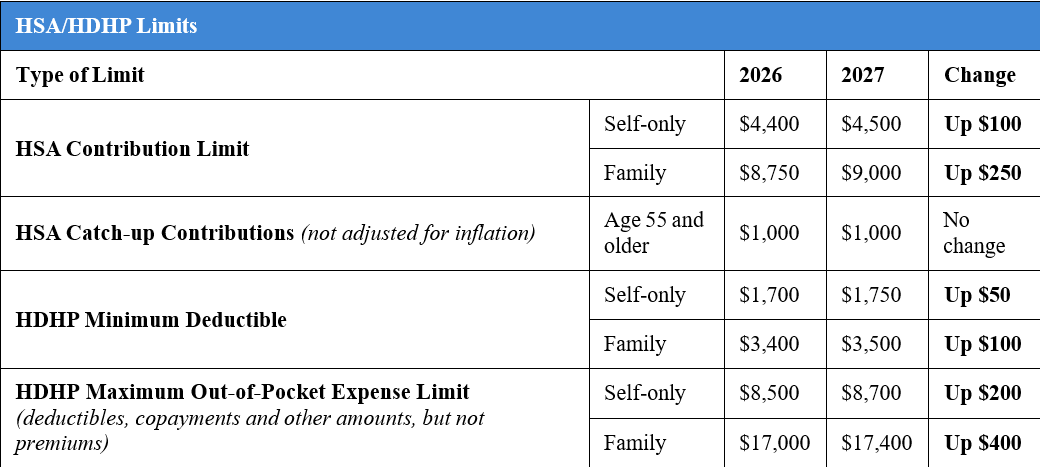
Individuals must be covered by an HDHP to be eligible for HSA contributions. To qualify as an HDHP, a health plan must satisfy requirements for minimum deductibles and OOPMs, which are adjusted annually for inflation. HSA contribution limits are also adjusted for inflation each year. The IRS has released the inflation-adjusted limits for HSAs and HDHPs for 2027. The HSA contribution limits will increase effective Jan. 1, 2027, while the HDHP cost-sharing limits will increase effective for plan years beginning on or after Jan. 1, 2027. Looking ahead, employers should take these steps:
- Check whether HDHP cost-sharing limits need to be adjusted for the 2027 limits; and
- Communicate HSA contribution limits for 2027 to employees as part of the enrollment
The following table contains the HDHP and HSA limits for 2027 compared to 2026. It also includes the catch-up contribution limit that applies to HSA-eligible individuals age 55 and older, which is not adjusted for inflation and stays the same from year to year.
Health FSA Contributions
The ACA imposes a dollar limit on employees’ pre-tax contributions to a health flexible spending account (FSA). This limit is indexed each year for cost-of-living adjustments. An employer may set their own dollar limit on employees’ contributions to a health FSA as long as the employer’s limit does not exceed the ACA’s maximum limit in effect for the plan year. For plan years beginning in 2026, the health FSA limit is $3,400. The IRS has not yet released the health FSA limit for plan years beginning in 2027.
Moving forward, employers with health FSAs should take these steps:
- Monitor future developments for the release of the health FSA limit for 2027;
- Confirm that employees will not be allowed to make pre-tax contributions in excess of the limit for the 2027 plan year (once the IRS releases the health FSA limit); and
- Communicate the health FSA limit to employees as part of the open enrollment
EBHRA Limit
An excepted benefit health reimbursement arrangement (EBHRA) is an employer-funded health care account that reimburses employees for their eligible medical expenses on a tax-free basis. Employers can use EBHRAs to supplement their traditional health plan coverage and help employees with their out-of-pocket medical expenses, including deductible, copayment and coinsurance amounts. Employers of all sizes may offer EBHRAs. Although an employer must offer a traditional health plan, employees are not required to enroll in the employer’s group coverage (or any other type of coverage) to be eligible for the EBHRA.
Only employers can contribute to HRAs, including EBHRAs. EBHRAs are subject to a maximum amount that may be made newly available for the plan year. This maximum amount is adjusted annually for inflation. For 2026 plan years, the contribution limit is $2,200. This limit increases to $2,250 for plan years beginning in 2027.
Employers that sponsor EBHRAs should take the following steps:
- Decide how much will be contributed to the EBHRA for eligible employees for the 2027 plan year, up to a maximum of $2,250; and
- Communicate the EBHRA’s annual benefit amount to employees as part of the open enrollment
Wellness Programs: Surcharges/Rewards
Health plans that impose a surcharge (or provide a reward) based on a health-related standard (e.g., not using tobacco or meeting a specific exercise target) must comply with nondiscrimination requirements under the Health Insurance Portability and Accountability Act (HIPAA). Among other requirements, health-contingent wellness programs must provide a reasonable alternative standard for qualifying for the reward (or avoiding the surcharge) and must disclose the alternative standard in all plan materials describing the surcharge or reward. Numerous class-action lawsuits have been filed against employers alleging that health plan premium surcharges related to tobacco use violate HIPAA’s nondiscrimination requirements. While some employers have successfully defended these lawsuits, other employers have entered into costly settlement agreements and legal challenges to tobacco surcharges remain an ongoing trend.
Given this increased scrutiny, employers should take the following steps to prepare for the 2027 plan year:
- Decide whether to impose a surcharge (or provide a reward) based on any health-related standard; and
- Ensure that any such surcharge or reward is provided through a wellness program that satisfies HIPAA’s nondiscrimination requirements, including explaining to participants that a reasonable alternative standard is available for avoiding the surcharge (or qualifying for the reward).
Mental Health Parity: Required Comparative Analysis for NQTLs
The Mental Health Parity and Addiction Equity Act (MHPAEA) requires parity between a health plan’s medical/surgical benefits and its mental health or substance use disorder (MH/SUD) benefits. These parity requirements apply to financial requirements and treatment limits for MH/SUD benefits. In addition, any nonquantitative treatment limitations (NQTLs) placed on MH/SUD benefits must comply with MHPAEA’s parity requirements. For example, NQTLs include prior authorization, step therapy protocols, network adequacy and medical necessity criteria.
MHPAEA requires health plans and issuers to conduct comparative analyses of the NQTLs used for medical/surgical benefits compared to MH/SUD benefits. This analysis must contain a detailed, written and reasoned explanation of the specific plan terms and practices at issue and include the basis for the plan’s or issuer’s conclusion that the NQTLs comply with MHPAEA. Plans and issuers must make their comparative analyses available to specific federal agencies or applicable state authorities upon request. In 2024, federal agencies released a final rule under MHPAEA that would have imposed stricter standards for comparative analyses for the plan year beginning in 2026. However, enforcement of this final rule has been put on hold by the Trump administration.
Although the final rule’s requirements are not being enforced, MHPAEA’s statutory requirement to conduct comparative analyses remains in effect. The U.S. Department of Labor’s (DOL) recent report to Congress makes clear that MHPAEA enforcement, particularly the comparative analysis requirement for employer-sponsored health plans, remains a priority. One of the report’s central messages is that health plans and issuers that take a proactive approach to compliance and maintain thorough comparative analyses tend to see faster DOL investigation resolutions and more favorable outcomes.
Considering this information, employers should take the following step:
- Reach out to the health plan’s issuer or third-party administrator (TPA) to confirm that comparative analyses of NQTLs will be updated, if necessary, for the plan year beginning in 2027.
Consider Expanded Options for Fertility Benefits
Employer-provided fertility benefits are experiencing significant growth, fueled by rising employee demand, new federal regulatory initiatives and expanding state insurance mandates. In May 2026, federal agencies proposed a new category of limited excepted benefits that employers could use to offer fertility benefits. The proposal builds on the federal government’s October 2025 guidance, which clarified that employers may offer fertility benefits through three existing excepted benefit pathways: a fully insured independent, noncoordinated excepted benefit policy; an EBHRA; and an employee assistance program offering coaching and navigator services.
The proposed rule would establish a new category of limited excepted benefits for fertility benefits, with the following main requirements:
- Substantially all benefits must be for the diagnosis, mitigation or treatment of infertility or related reproductive health conditions;
- Benefits are capped at a combined lifetime maximum of $120,000 for the participant and their beneficiaries, indexed for inflation for plan years beginning after 2027;
- The benefits must be provided under a separate policy or otherwise not be an integral part of the plan maintained by the same plan sponsor; and
- The plan or insurance issuer must provide a written notice to participants and beneficiaries that clearly describes the coverage, including its benefits and limitations, how to access in‑network providers and how to submit claims. This notice must be provided at the first opportunity to enroll, annually thereafter and upon request.
If finalized, the proposed changes would apply for plan years beginning on or after Jan. 1, 2027, although federal agencies have requested feedback on whether the proposed changes should be applicable sooner.
Employers that are interested in offering fertility benefits (or expanding their coverage of fertility treatment) for 2027 should consider the following steps:
- Contact their issuers or TPAs, as applicable, to understand available options for adding (or expanding) fertility coverage under their current group health plan and to determine what limitations or parameters should apply to the coverage;
- Explore standalone coverage options for fertility benefits, such as through an HRA or health FSA, or as an excepted benefit; and
- Stay current on federal developments regarding proposed expansions of fertility benefit coverage
Open Enrollment Notices
Employers that sponsor health plans should provide certain benefits notices in connection with their plans’ open enrollment periods. Some of these notices must be provided at open enrollment time, such as the SBC. Other notices, such as the Women’s Health and Cancer Rights Act (WHCRA) notice, must be distributed annually. Although these annual notices may be provided at different times throughout the year, employers often choose to include them in their open enrollment materials for administrative convenience.
In addition, employers should review their open enrollment materials to confirm that they accurately reflect the terms and cost of coverage. In general, any plan design changes for 2027 should be communicated to plan participants either through an updated SPD or an SMM.
SBCs
The ACA requires health plans and health insurance issuers to provide an SBC to applicants and enrollees each year at open enrollment or renewal time. Federal agencies have provided a template for the SBC, which health plans and issuers are required to use. To comply with the SBC requirements, employers should include an updated SBC with open enrollment materials.
Take note that the plan administrator is responsible for providing the SBC for self-funded plans. For insured plans, the issuer usually prepares the SBC. If the issuer prepares the SBC, an employer is not required to also prepare an SBC for the health plan, although they may need to distribute the SBC prepared by the issuer.
Medicare Part D Notices
Employers that provide prescription drug coverage to individuals who are eligible for Medicare Part D must inform these individuals whether their prescription drug coverage is creditable, meaning that the employer’s prescription drug coverage is at least as good as Medicare Part D coverage. There is no penalty or fee for employers that offer prescription drug coverage that is noncreditable. Noncreditable prescription drug coverage can still be a valuable benefit for employees. However, individuals need to know whether their prescription drug coverage is creditable or noncreditable. If the coverage is noncreditable, and Medicare-eligible individuals fail to enroll in Part D during their initial enrollment period, they can be subject to a higher Part D premium if they enroll in Part D at a later date.
Employers should note that, for 2027 and beyond, the simplified determination method for establishing whether prescription drug coverage is creditable no longer applies. Employers must use a revised methodology that requires health plans to pay, on average, at least 73% of a participant’s drug expenses to be considered creditable coverage (increased from 60% under the prior methodology).
The Medicare Part D notice generally must be provided at various times, including when an individual enrolls in the plan and each year before Oct. 15 (when the Medicare annual open enrollment period begins). Model notices are available on the Centers for Medicare and Medicaid Services’ website.
Annual CHIP Notices
Health plans covering residents in a state that provides a premium subsidy to low-income children and their families to help pay for employer-sponsored coverage must send an annual Children’s Health Insurance Program (CHIP) notice about the available assistance to all employees residing in that state. The DOL has provided a model notice. Employers should confirm they are using the most recent model notice, as the DOL updates it regularly.
Initial COBRA Notices
The Consolidated Omnibus Budget Reconciliation Act (COBRA) applies to health plans sponsored by employers with 20 or more employees. Health plan administrators must provide an initial COBRA notice to new participants and certain dependents within 90 days after plan coverage begins. The initial COBRA notice may be incorporated into the plan’s SPD. A model initial COBRA notice is available from the DOL.
SPDs
Plan administrators must provide an SPD to new participants within 90 days after plan coverage begins. Any changes made to the plan should be reflected in an updated SPD booklet or described to participants through an SMM. Also, an updated SPD must be furnished every five years if changes are made to SPD information or the plan is amended. Otherwise, a new SPD must be provided every 10 years.
Notices of Patient Protections
Under the ACA, health plans and issuers that require the designation of a participating primary care provider must permit each participant, beneficiary and enrollee to designate any available participating primary care provider (including a pediatrician for children). Additionally, plans and issuers that provide obstetrical/gynecological care and require a designation of a participating primary care provider may not require preauthorization or referral for such care. If a health plan requires participants to designate a participating primary care provider, the plan or issuer must provide a notice of these patient protections whenever the SPD or similar description of benefits is provided to a participant. If an employer’s plan is subject to this notice requirement, the employer should confirm that it is included in the plan’s open enrollment materials. This notice may be included in the plan’s SPD or benefit summary provided by the issuer or TPA. Model language is available from the DOL.
Grandfathered Plan Notices
If an employer has a grandfathered plan, it should include information about the plan’s grandfathered status in plan materials describing the coverage under the plan, such as SPDs and open enrollment materials. Model language is available from the DOL.
Notices of HIPAA Special Enrollment Rights
An employer’s health plan must notify each eligible employee of their special enrollment rights under HIPAA at or before enrollment. This notice may be included in the plan’s SPD or benefit summary provided by the issuer or TPA.
HIPAA Privacy Notices
The HIPAA Privacy Rule requires covered entities (including health plans and issuers) to provide a Notice of Privacy Practices (or Privacy Notice) to each individual who is the subject of protected health information (PHI). Health plans are required to send the Privacy Notice at certain times, including to new enrollees at the time of enrollment. Also, at least once every three years, health plans must either redistribute the Privacy Notice or notify participants that the Privacy Notice is available and explain how to obtain a copy.
Self-insured health plans must maintain and provide their own Privacy Notices. However, special rules apply for fully insured plans, where the issuer, not the plan itself, is primarily responsible for the Privacy Notice.
Special Rules for Fully Insured Plans
The sponsor of a fully insured health plan has limited responsibilities with respect to the Privacy Notice, including the following:
- If the sponsor of a fully insured plan has access to PHI for plan administrative functions, they are required to maintain a Privacy Notice and provide the notice upon request; and
- If the sponsor of a fully insured plan does not have access to PHI for plan administrative functions, they are not required to maintain or provide a Privacy Notice.
A plan sponsor’s access to enrollment information, summary health information and PHI that is released pursuant to a HIPAA authorization does not qualify as having access to PHI for plan administration purposes.
A model Privacy Notice is available through the U.S. Department of Health and Human Services.
WHCRA Notices
Health plans and issuers must provide a notice of participants’ rights to mastectomy-related benefits under the WHCRA at the time of enrollment and on an annual basis. The DOL’s compliance assistance guide includes model language for this disclosure.
SARs
Plan administrators required to file Form 5500 must provide participants with a narrative summary of the information in Form 5500, called a summary annual report (SAR). Health plans that are unfunded (that is, benefits are payable from the employer’s general assets and not through an insurance policy or trust) are not subject to the SAR requirement. The plan administrator generally must provide the SAR within nine months of the close of the plan year. If an extension of time to file Form 5500 is obtained, the plan administrator must furnish the SAR within two months after the close of the extension period. A model notice is available from the DOL.
Wellness Program Notices
Health plans that include wellness programs may be required to provide certain notices regarding the program’s design. As a general rule, these notices should be provided when the wellness program is communicated to employees and before employees provide any health-related information or undergo medical examinations. These notices are required in the following situations:
- HIPAA Wellness Program Notice—HIPAA imposes a notice requirement on health-contingent wellness programs offered under health plans. Health-contingent wellness plans require individuals to satisfy standards related to health factors (e.g., not smoking) to obtain rewards or avoid surcharges. The notice must disclose the availability of a reasonable alternative standard to qualify for the reward (and, if applicable, the possibility of waiver of the otherwise applicable standard) and be included in all plan materials describing the terms of a health-contingent wellness program. The DOL’s compliance assistance guide includes a model notice that can be used to satisfy this requirement; and
- Americans with Disabilities Act (ADA) Wellness Program Notice—Employers with 15 or more employees are subject to the ADA. Wellness programs that include health-related questions or medical exams must comply with the ADA’s requirements, including an employee notice requirement. Employers must give participating employees a notice that tells them what information will be collected as part of the wellness program, with whom it will be shared and for what purpose, as well as include the limits on disclosure and the way information will be kept confidential. The U.S. Equal Employment Opportunity Commission has provided a sample notice to help employers comply with this ADA requirement.
ICHRA Notices
Employers may use individual coverage health reimbursement arrangements (ICHRAs) to reimburse their eligible employees for insurance policies purchased in the individual market or for Medicare premiums. Employers with ICHRAs must provide a notice to eligible participants about the ICHRA and its interaction with the ACA’s premium tax credit. In general, this notice must be provided at least 90 days before the beginning of each plan year. Employers may provide this notice at open enrollment time if it is at least 90 days prior to the beginning of the plan year. A model notice is available for employers to use to satisfy this notice requirement.
Links and Resources
- Revenue Procedure 2026-24, which includes the inflation-adjusted limits for HSAs and HDHPs for 2027
- Model notices for group health plans, including the WHCRA notice
- Model COBRA notices for group health plans
© 2026 Zywave, Inc
Contact us today at 518-373-4111 or request a complimentary consultation for more insurance guidance.